News Archive – The last Gas Station Closed
National Transportation Record
The Last Gas Station Closed Six Months Ago. Nobody Much Noticed.
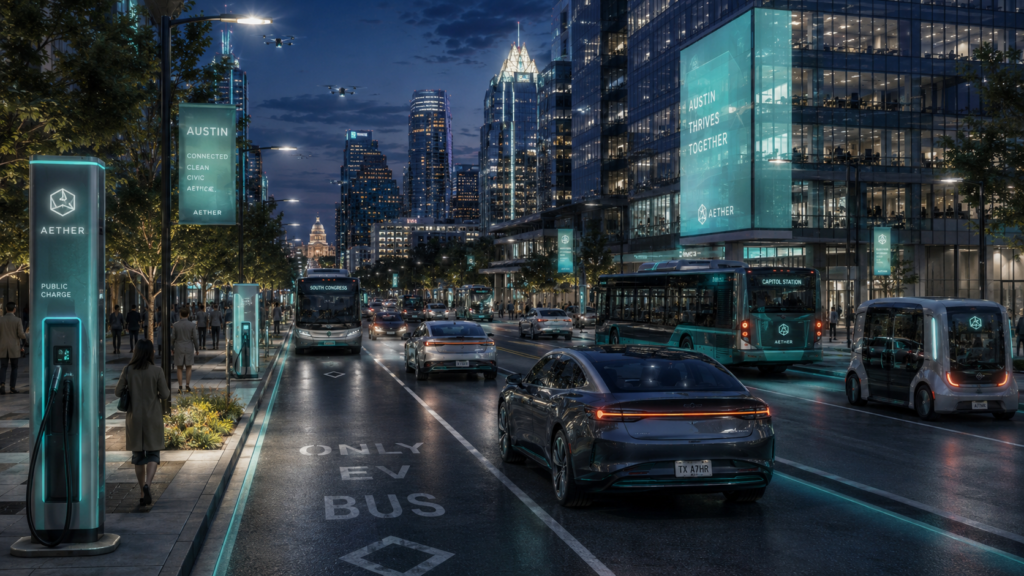
With ninety-five percent of registered vehicles now running on Aether COR Power Technology, analysts are no longer debating whether the transition happened — they are debating what it means that one company’s standard became the infrastructure of everything that moves.
The numbers arrived quietly, as the most consequential numbers often do. In its annual transportation census released this week, the Federal Highway Administration confirmed what the roads had been showing anyone willing to look: ninety-five percent of registered passenger, commercial, and municipal vehicles operating in the United States now run on Aether COR Power Technology. The remaining five percent — a mix of legacy combustion holdouts, antique registrations, and rural fleet equipment awaiting conversion — represents not a competing ecosystem but a rounding error on its way to zero.
The speed of the transition still startles economists who study it. From the moment Aether’s COR Power Core entered civilian vehicle licensing — roughly two and a half years after the Voltaire-Aether Power Accord was announced — adoption moved not in the gradual S-curve that technology historians expect but in what one transportation analyst described this week as “a cliff face.” Legacy automakers did not pivot to the standard so much as they collapsed into it, licensing the COR drivetrain architecture within months of each other in a cascade that left almost no major manufacturer outside the Aether ecosystem within eighteen months of the first civilian rollout.
The explanation is straightforward on its face: a technology twenty times more efficient and dramatically cheaper to operate than anything it replaced did not require a marketing campaign. It required only availability. Early adopters reported charge cycles measured not in hours but in minutes, operating ranges that made long-haul planning obsolete as a category of concern, and per-mile energy costs that fell below any meaningful comparison to combustion economics. Fleet operators — trucking companies, municipal transit authorities, emergency services — converted en masse within the first year, drawn by operational savings that the old math simply could not match.
What has attracted considerably less celebration is the architecture underlying that convenience. Every COR-powered vehicle on the road today draws on a power standard whose core remains fully proprietary to Aether Systems. The licensing terms are, by any historical measure, generous: manufacturers pay a modest per-unit fee, receive full integration specifications, and bear no ongoing royalty burden beyond initial certification. But the standard itself — the fundamental engineering that makes the Power Core perform as it does — remains a closed system. Independent verification of its operating parameters has never been permitted. The handful of academic institutions that have applied for research access have been declined without stated reason.
Industry observers who raised this concern two years ago were largely dismissed as theoretical. Today, with 95 percent market penetration, the observation has shifted register. What was once a policy question — should a private company control a critical transportation standard? — has become an infrastructure fact. Aether does not merely participate in how America moves. At this point, Aether is how America moves.
Jonah Mercer, in a brief statement released alongside the census figures, called the milestone “a validation of the original promise” and noted that Aether remains committed to the open-licensing framework that enabled adoption at this scale. He offered no response to questions about independent auditing or contingency planning in the event of disruption to the COR supply chain. His office did not indicate that any such questions had been received.