
Aether Absorbs Voltera Mobility
June 7th – 12 YEARS BEFORE THE FALL
Aether Absorbs Voltera Mobility in Sweeping Corridor Deal
The acquisition hands a single private company control over Austin’s transit lines, its largest battery manufacturer, and a land corridor stretching east toward the airport — raising questions few officials seem willing to ask aloud.
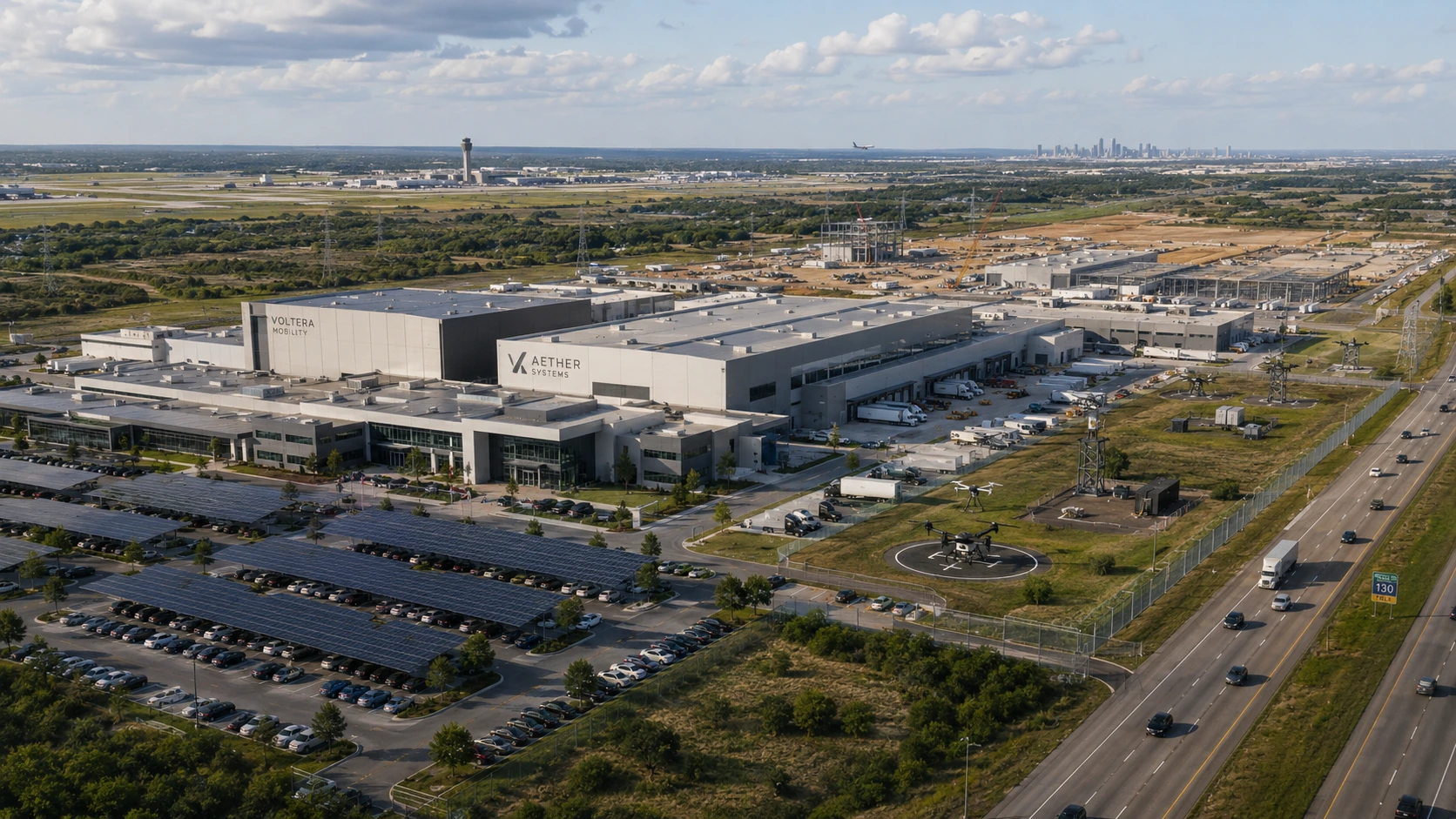
The Voltera Mobility manufacturing campus north of Austin-Bergstrom International Airport, now under Aether Systems control. (Photo placeholder)
Aether Systems announced this week the acquisition of Voltera Mobility, the electric vehicle and battery manufacturer whose campus sits north of Austin-Bergstrom International Airport along the Hwy 130 corridor. The purchase price was not disclosed. What was disclosed — the breadth of what Aether now controls — drew considerably less attention than the figure might have.
With the deal closed, Aether holds Voltera’s full manufacturing campus, its battery research division, its autonomous vehicle systems portfolio, and substantial land holdings stretching east from the airport. The company says the site will anchor a new clean-mobility and logistics initiative serving Central Texas.
It was not the first time that phrase had appeared in an Aether press release. It will likely not be the last.
Within months of the purchase Aether began acquiring adjacent parcels through a network of subsidiaries tied variously to energy storage, robotics development, transit support, and automated freight. The individual purchases were modest in scale. In aggregate they describe something considerably larger — a contiguous private land holding east of Austin running from the airport corridor to the edge of established residential zones.
“The map of what they now control east of Austin is not a campus. It is a territory.”
— Corridor Report analysis, June 2038Residents near the corridor noticed first. Land pressure. Rising property taxes. Drone testing equipment on parcels that had been empty farmland eighteen months prior. The speed of it, several said, was the part that felt wrong. Not any single thing. The speed.
Local business groups praised the expansion as a major economic win, citing projected job creation figures Aether provided in its announcement materials. The Greater Austin Chamber of Commerce called the deal “a landmark moment for Central Texas competitiveness.”
City officials echoed the sentiment without exception. No council member requested an independent assessment of the consolidated land holdings. No one asked, at least not on the public record, what a single private company controlling the city’s transit infrastructure, its primary battery manufacturer, and a growing eastern land corridor might look like in ten years.
Aether called the concerns of corridor residents premature.
The company’s statement used the word partnership eleven times.